
How Long Does Custom Apparel Printing Take?

Updated: Aug 27
When ordering custom shirts, polos, hoodies, uniforms, or other branded apparel, one of the most important questions is:
How long will my order take?
For most custom apparel orders, turnaround time depends on more than just the printing itself.
Garment availability, artwork approval, decoration method, order size, shipping, and production scheduling can all affect when the finished order is ready.
If you are ordering apparel for an event, employee onboarding, seasonal uniforms, or a company deadline, understanding the production timeline can help you avoid unnecessary rush charges and last-minute problems.
How Long Does T-Shirt Printing Take?
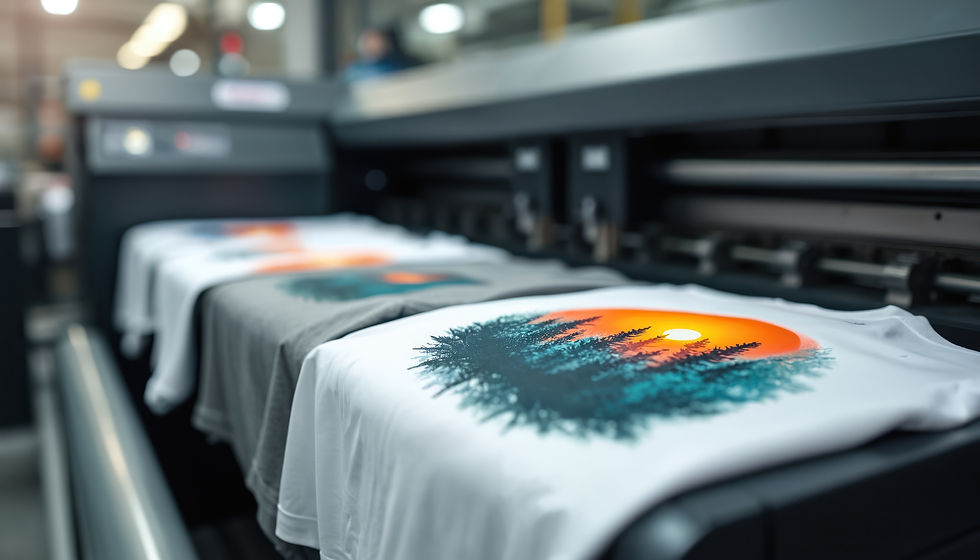
While custom apparel is very broad, typically t-shirt only orders will be much quicker to produce than embroidery. The amount of machines and human time to produce 100 printed shirts versus 100 embroidered shirts is much less.
How Long Does Embroidery Take?
Embroidery is a more complex decoration method that requires many steps and time scheduled for the machines. While it may take longer than t-shirt printing, I would be cautious if companies are not able to produce your order in the typical 7-10 business day turnaround time.
What Is the Typical custom apparel turnaround time?
A standard custom apparel order will often take approximately 7–10 business days after artwork approval and garment availability are confirmed.
That does not necessarily mean every order will take exactly 7–10 business days.
Some orders can move faster.
Others may require additional time because of:
Large quantities
Special-order garments
Complex artwork
Multiple decoration locations
Embroidery
Shipping delays
Out-of-stock sizes or colors
Seasonal production volume
The most important distinction is understanding when the production clock actually begins.
When Does Turnaround Time Start?
Turnaround usually should not be counted from the moment you first request a quote.
Production generally begins after several things are finalized:
Garments are selected
Quantities and sizes are confirmed
Artwork is submitted
Artwork is approved
Payment or order authorization is completed
Garments are available for production
If one of those steps is delayed, the production timeline may also be delayed.
Artwork Approval Can Affect Your Timeline
Artwork is one of the most common reasons an apparel order takes longer than expected.
Before production begins, the printer needs artwork that can be properly reproduced on the garment.
Potential artwork issues include:
Low-resolution logos
Missing vector files
Incorrect colors
Missing fonts
Unclear placement instructions
Artwork that needs to be recreated
Changes requested after proofing
If your artwork is ready before placing the order, production can usually move more efficiently.
What Artwork Files Should You Provide?
Whenever possible, provide high-quality artwork.
Common useful file types include:
AI
EPS
SVG
Vector PDF
High-resolution PNG
A screenshot copied from a website or a small JPEG may not be suitable for professional apparel production.
If your logo needs to be recreated or cleaned up, additional design time may be necessary before printing can begin.
Garment Availability Matters
The shirt or polo you want has to be available in the correct:
Color
Style
Size
Quantity
Even a straightforward order can be delayed if one particular size is out of stock.
For example, you may choose a polo that is available in:
Small
Medium
Large
XL
but temporarily unavailable in:
2XL
3XL
The order may need to wait for inventory, use an alternative garment, or split production.
This is one reason businesses should avoid waiting until the last possible moment to place apparel orders.
Order Quantity Can Affect Turnaround
A 24-shirt order and a 2,000-shirt order require very different production schedules.
Higher quantities can require additional time for:
Garment receiving
Sorting
Printing
Pressing
Embroidery
Quality control
Folding
Packaging
Large orders should be planned earlier whenever possible.
If you are preparing a major employee rollout, event, or multi-location order, giving your apparel provider advance notice can help reserve production capacity.
Decoration Method Can Affect Production Time
Different decoration methods have different workflows.
DTF Printing
DTF printing can be efficient for full-color artwork and a wide range of garment types.
Production generally involves:
Preparing artwork
Printing transfers
Preparing garments
Applying transfers with heat
Quality control
Turnaround still depends on quantity and the number of print locations.
Screen Printing
Screen printing requires production setup before garments are printed.
More complex designs may require additional setup depending on:
Number of colors
Number of print locations
Artwork complexity
Large screen-printing runs can be very efficient once production is established.
Embroidery
Embroidery can require additional preparation because artwork must first be digitized into an embroidery file.
Production time can also be affected by:
Stitch count
Number of garments
Number of embroidery locations
Logo complexity
Thread-color changes
A small embroidered logo may be straightforward, while a large detailed design can require considerably more machine time.
Multiple Print Locations Take Longer
Every additional decoration location adds another production step.
For example:
One Location
Left-chest logo
Two Locations
Left-chest logo + full back
Three Locations
Left chest + full back + sleeve
A 100-shirt order with one print location requires significantly fewer production steps than 100 shirts with three separate decoration locations.
If turnaround time and budget are major concerns, simplifying the decoration layout can help.
How Long Does a Large Custom Apparel Order Take?
Large orders should be discussed with the printer before assuming a standard turnaround.
An order of:
50 shirts
may fit easily into a normal production schedule.
An order of:
500 shirts
requires much more production capacity.
An order of:
5,000 shirts
may require production planning, staged garment deliveries, multiple production days, and coordinated packaging or distribution.
For large-volume projects, the apparel provider should establish a realistic timeline before the order is approved.
What Is a Rush Apparel Order?
A rush order is an order that must be completed faster than the normal production schedule.
Rush production may require:
Expedited garment shipping
Production rescheduling
Overtime
Priority artwork processing
Faster approvals
Special handling
Because of this, rush orders may include additional charges.
Availability also matters.
A printer cannot always guarantee a rush order simply because a customer is willing to pay more.
Production capacity and garment inventory still have to make the deadline possible.
How Fast Can Custom Shirts Be Printed?
Some projects can be produced in only a few business days when:
Artwork is ready
Garments are in stock
Quantity is manageable
Decoration is straightforward
Production capacity is available
However, businesses should not plan every apparel order around the fastest possible turnaround.
A better strategy is to build in enough time for unexpected issues.
How Early Should You Order Shirts for an Event?
For events, I would avoid planning around the exact production deadline.
If your event is on Friday, you should not ideally plan to receive the shirts on Thursday.
Build in a buffer.
For many events, ordering at least 2–3 weeks before the apparel is needed provides more flexibility for:
Artwork changes
Garment substitutions
Shipping delays
Size adjustments
Production issues
For major events or large orders, even more lead time may be appropriate.
How Early Should Businesses Order Employee Uniforms?
Businesses should think differently about uniforms than one-time event apparel.
If employees need uniforms continuously, the goal should be to avoid emergency ordering entirely.
Consider maintaining:
Approved garment styles
Standard logo placements
Employee size records
Replacement inventory
Scheduled ordering periods
For example, a company might review apparel needs:
Monthly
Quarterly
Twice per year
The right frequency depends on hiring volume and employee turnover.
New Hire Apparel Can Create Delays
One of the most common apparel challenges for growing companies is outfitting new employees quickly.
If every new hire requires a separate custom order, the company may constantly be waiting for apparel.
A better approach may be to keep a small inventory of standard garments in commonly used sizes.
For example:
Medium
Large
XL
2XL
When a new employee starts, the company can issue apparel immediately and replenish inventory during the next scheduled order.
Seasonal Demand Can Affect Turnaround
Apparel production is not always equally busy throughout the year.
Demand may increase around:
Back-to-school season
Fall uniform ordering
Holiday merchandise
Spring sports
Company events
Large community events
Ordering early during busy periods can help reduce the risk of delays.
Garment distributors may also experience inventory pressure during peak seasons.
How Can You Get Your Order Faster?
There are several ways to reduce unnecessary delays.
Have Artwork Ready
Provide production-ready artwork when requesting your quote.
Approve Proofs Quickly
Do not allow artwork approvals to sit unanswered for several days if you have a firm deadline.
Choose Available Garments
If your first-choice garment is backordered, consider a comparable alternative.
Finalize Sizes Before Ordering
Constantly changing quantities and sizes can delay purchasing and production.
Limit Last-Minute Changes
Changing artwork or print locations after approval may require production to restart.
Tell the Printer Your Deadline Immediately
Do not wait until the order is already in production to mention that the shirts are needed for an event next week.
The deadline should be one of the first details discussed.
What Information Should You Provide When Requesting a Quote?
To receive a more accurate production estimate, provide:
Garment type
Quantity
Size breakdown
Garment color
Artwork
Decoration location
Printing or embroidery preference
Required delivery date
Shipping or pickup requirements
The more complete the information, the easier it is to provide accurate pricing and turnaround.
What Causes Custom Apparel Orders to Be Delayed?
Common causes include:
Backordered garments
Late artwork approval
Poor-quality artwork
Changing quantities
Changing garment styles
Adding print locations
Delayed payment
Shipping issues
Major production-volume spikes
Many of these delays can be avoided with better planning.
Should You Order Early Even If You Do Not Need the Shirts Yet?
Usually, yes—within reason.
There is little downside to giving yourself additional production time when the garment, artwork, and quantity are already known.
Ordering early also provides more flexibility if your first-choice garment becomes unavailable.
For businesses, planning apparel needs ahead of time can also reduce rush fees and administrative work.
How Long Should You Plan for Custom Apparel?
For a typical order, a reasonable expectation is approximately 7–10 business days after the order, artwork, and garment availability are finalized.
However, the safest approach is to tell your apparel provider the actual date the order is needed.
Do not simply ask:
“How fast can you make it?”
Instead say:
“We need these shirts in hand by September 15.”
That allows the provider to work backward from the real deadline.
Get a Turnaround Estimate for Your Apparel Order
FTF Design Co. produces custom T-shirts, polos, hoodies, uniforms, workwear, and branded apparel for businesses and organizations.
If you have a specific deadline, provide your quantity, garment needs, artwork, and required date when requesting a quote.
We can help determine garment availability, decoration options, pricing, and a realistic production schedule before your order begins.
View our custom apparel pricing or request an exact quote for your upcoming project.


Comments